A private money tracker that never touches your bank
tadoy's money module is a plain ledger — what you're saving toward, what you owe, who owes you, and the subscriptions quietly leaving each month. No bank linking, no Plaid, no sync. It sits on the daily page next to your habits and journal, not in a separate finance app.
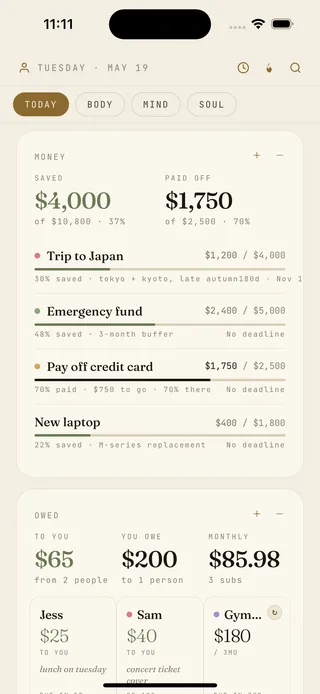
What's in the money module
- Savings goals — a target, what's in, and the percentage there. A trip, a buffer, a thing you're working toward.
- Debt payoff — what's left to clear and how far along, in plain numbers.
- Owed, both ways — money owed to you and money you owe, per person, with a note and a date.
- Subscriptions — recurring items rolled into one monthly total, with renewal dates.
- A small weekly ledger — spend noted plainly, no categories to maintain.
- No bank linking — nothing connected, nothing aggregated; you enter what matters.
- Widget — the month's number on the home or lock screen if you want it, off by default.
A ledger, not a budgeting app
tadoy's money module is not a budgeting system, not a net-worth dashboard, and not bank-linked. If you want zero-based budgeting or automatic categorisation, YNAB or Copilot do that well — tadoy is the quiet ledger that holds the few money facts you actually check, next to the rest of your day.
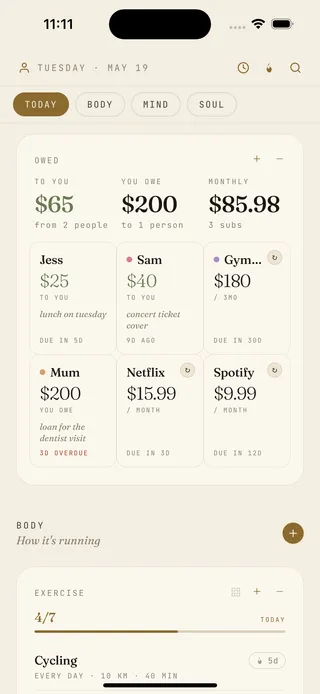
Money owed, and the subscriptions you forget
The part people actually lose track of isn't spending — it's the twenty dollars a friend owes, the loan you made months ago, and the three subscriptions renewing on dates you've never seen together. The owed view keeps both directions in one place per person, and the recurring items add up to a single monthly number — so the quiet spend is visible without handing a finance app your bank login.
How tadoy compares to finance apps
Each of these does something tadoy doesn't and isn't trying to.
- YNAB — rigorous zero-based budgeting for people who want a full system. tadoy isn't a budgeting app.
- Copilot / Rocket Money — bank-linked spend tracking and subscription cancelling. tadoy links nothing; it's manual and on-device.
- Mint-style aggregators — pull every account into one dashboard. tadoy is the opposite: nothing connected, nothing synced.
- Splitwise — social shared-expense splitting with friends. tadoy's owed view is a private personal ledger, not a settle-up network.
- A note or spreadsheet — what most people use for who-owes-what. tadoy is that, structured, on the daily page.
Why no bank linking
Every mainstream money app starts by asking for your bank login. tadoy asks for nothing — no Plaid, no aggregation, no server copy of your finances. You enter the handful of numbers you want to watch and they stay on your device. It's less automatic on purpose; it's also the only money tool here you don't have to trust with your bank.
Privacy
Savings goals, debts, what you're owed and your subscriptions live on your device — not synced to tadoy's servers, not used to train any model. The same on-device posture as journal, mood, body and habits. Full detail on the privacy page.
See the daily page Read about the habits module
Common questions
- Does it link to my bank?
- No. No Plaid, no aggregation, no bank login. You enter what matters and it stays on the device.
- Is it a budgeting app?
- No — a plain ledger (savings, debts, owed, subscriptions), not zero-based budgeting or net-worth tracking.
- Can it track who owes me money?
- Yes — money owed to you and money you owe, per person, with a note and a date.
- Does it track subscriptions?
- Yes — recurring items roll up into a monthly total with renewal dates.
- Is the data private?
- Yes. On-device, not synced to our servers, not used for training.
- Does it work offline?
- Yes, fully — it's manual and local, so it needs no connection.